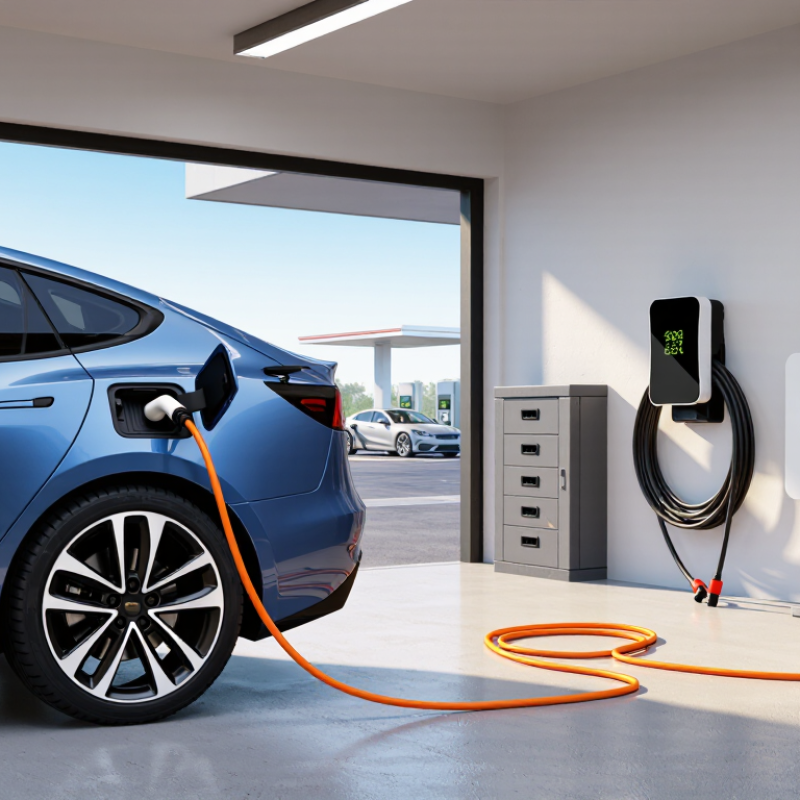
| AC Level 1 |
120 V; usually 12–16 A on a standard household circuit |
Approximately 1.4–1.9 kW |
Household AC plug with a vehicle-specific connector |
Most battery-electric vehicles and plug-in hybrid vehicles equipped for AC charging |
Overnight charging, low daily mileage, apartments, and locations without dedicated high-power wiring |
Compatible with nearly all EVs, but charging is slow. A typical 60 kWh battery may require more than 30 hours for a full charge under ideal conditions. |
| AC Level 2: Basic |
208–240 V; commonly 16–32 A |
Approximately 3.3–7.7 kW |
J1772 or an equivalent vehicle-specific AC connector |
Most EVs and plug-in hybrids with an AC onboard charger |
Home charging, workplaces, hotels, and daily driving |
Choose a charger at or below the vehicle’s maximum AC input. A vehicle limited to 7.2 kW will not charge faster from an 11 kW or 19.2 kW AC unit. |
| AC Level 2: High Output |
208–240 V; commonly 40–80 A, subject to circuit capacity |
Approximately 9.6–19.2 kW |
J1772 or an equivalent vehicle-specific AC connector |
EVs with a high-capacity AC onboard charger and suitable electrical equipment |
High daily mileage, fleet parking, and reducing charging time at home |
Check the vehicle specification first. Many EVs accept about 7.2–11 kW AC, while some accept up to approximately 19.2 kW. The vehicle’s onboard charger is the limiting component. |
| AC Three-Phase |
Typically 230/400 V in regions using three-phase supply |
Approximately 11–22 kW for compatible vehicles |
Type 2 or another regional AC standard |
Vehicles with a compatible three-phase onboard charger and connector |
Residential, commercial, and destination charging in regions with three-phase infrastructure |
Confirm both the vehicle’s AC phase capability and the site’s electrical supply. A vehicle that supports single-phase charging may use only part of the available power. |
| DC Fast Charging: Standard |
High-voltage direct current supplied by an external charger |
Approximately 25–100 kW |
CCS, NACS, CHAdeMO, or another regional DC standard |
Battery-electric vehicles with a DC fast-charge inlet; most plug-in hybrids do not support this power level |
Road trips, public charging, and rapid top-ups |
Compare the charger connector with the vehicle inlet and check the vehicle’s maximum DC acceptance rate. A 100 kW charger cannot make a vehicle accept more than its rated limit. |
| DC Fast Charging: High Power |
High-voltage direct current with liquid-cooled cables often used at higher ratings |
Approximately 150–350 kW |
CCS, NACS, or another compatible high-power DC standard |
Vehicles specifically engineered for high-power DC charging and equipped with a compatible inlet |
Long-distance travel and short charging stops |
Confirm the vehicle’s peak DC rate, battery voltage, thermal limits, and charging curve. Peak power is usually available only within a limited battery state-of-charge range. |
| Portable EV Charger |
Usually 120 V or 208–240 V, depending on the interchangeable supply plug |
Approximately 1.4–9.6 kW, depending on voltage and current |
Household plug, industrial plug, J1772, Type 2, or another vehicle-specific connector |
EVs supporting the selected input voltage, current, and connector |
Travel, emergency charging, temporary installations, and locations without a wall-mounted unit |
Verify the outlet rating, grounding, circuit breaker, plug configuration, and the vehicle’s AC input limit. Never use an adapter that is not rated for the required current. |
| Plug-In Hybrid Charging |
Usually 120 V Level 1 or 208–240 V Level 2 AC |
Approximately 1.4–7.7 kW, depending on the vehicle |
Household AC plug, J1772, Type 2, or another regional AC connector |
Plug-in hybrid vehicles with an external charging port |
Overnight home charging and regular electric-only commuting |
High-power DC charging is generally unavailable. Select an AC charger that matches the vehicle’s onboard charger rather than its gasoline-engine performance. |
| Fleet or Multi-Port Charger |
Single-phase or three-phase supply; power may be shared among ports |
Commonly 7–22 kW per AC port, with dynamic load management |
Regional AC or DC connector standards |
Mixed EV fleets when each port supports the required connector and charging protocol |
Workplaces, apartment buildings, depots, and commercial parking facilities |
Check the available site capacity and whether output is shared. Multiple vehicles may receive less power when several ports operate simultaneously. |
 Zap Charger